Arizona to bear the brunt of Colorado River cuts for two years as long-term talks continue

Arizona and the other Lower Basin states will bear the brunt of cuts to Colorado River water over the next two years, while they continue to negotiate a longer-term agreement with the Upper Basin, the federal government announced Friday morning.
But for now, Arizona will avoid the massive cuts to the Central Arizona Project, a series of canals that supplies Colorado River water to the metropolitan Phoenix and Tucson areas, that the federal government proposed earlier this year.
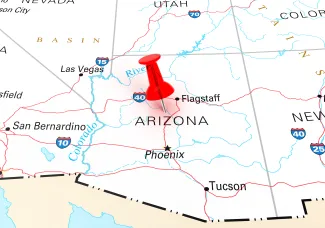
The Lower Basin states — Arizona, California and Nevada — will collectively reduce their usage by 1.25 million acre-feet in both 2027 and 2028, more than twice the largest reductions required under the current guidelines that expire at the end of the year.
The Lower Basin states have also committed to conserving an additional 700,000 acre-feet of water through 2028.
An acre-foot of water is enough to cover an acre of land to a depth of one foot, or about 325,851 gallons. That’s enough to provide three homes in Arizona a year of water, on average.
The Lower Basin states praised the federal government for releasing a two-year plan that would give those that rely on the river more stability and for allowing them to implement their own plan for dealing with the cuts. That plan would still put the biggest burden on Arizona to cut 760,000 acre-feet per year, with annual reductions of 440,000 and 50,000 acre-feet to California and Nevada, respectively.
But the Lower Basin states also insisted that, over the coming decade, the Upper Basin states — Colorado, New Mexico, Utah and Wyoming — would have to offer up some mandatory cuts of their own.
“California, Arizona, and Nevada have shown that states can compromise, make difficult decisions, and reduce water use when the river demands it,” JB Hamby, California’s Colorado River Commissioner, said in a statement. “But three states cannot carry the responsibility of all seven. California is prepared to discuss greater flexibility for the Upper Basin than the Colorado River Compact otherwise affords. That flexibility must be matched by robust action from Colorado, Utah, Wyoming, and New Mexico to bring demand in line with what the river can supply and maintain sustainable deliveries to the Lower Basin and Mexico.”

The Colorado River is a vital source of drinking water for 40 million people in the seven states, Mexico and for 30 Native American tribes, and it provides water for agriculture and hydroelectricity. Amid a 25-year megadrought, the river’s flows have decreased by more than 20% since 2000.
The cuts and conservation efforts in the Lower Basin are aimed at stabilizing water levels in Lake Powell and Lake Mead, the system’s two key reservoirs, whose water levels fell last month to their lowest point since 1957.
In an August 19 PBS special on the Colorado River, Brad Udall, a water and climate scientist at Colorado State University, described both reservoirs as being just above deadpool, the point at which water drops too low to flow past a dam by gravity.
Reaching deadpool would turn those reservoirs into nothing more than concrete basins where water evaporates, he said.
The seven basin states have been attempting to negotiate an updated water agreement for about three years, but blew past several deadlines as the Upper Basin states have refused to agree to mandatory cuts to their water usage during dry years, which the Lower Basin states have been subject to for years.
Becky Mitchell, Colorado’s water commissioner, has been firm that her state already deals with mandatory cuts, they’re just from Mother Nature, not the U.S. government. The Colorado River is fed by melting snowpack in the Rocky Mountains, which is at a record low this year.
The Lower Basin states have been equally as insistent, after decades of decreasing their water use, that the Upper Basin states must agree to government-mandated cuts of at least a small portion of its water in dry years.
“The actions in the Lower Basin in recent decades to protect the system have demonstrated how much we can accomplish when we all join together as part of the solution,” Tom Buschatzke, director of the Arizona Department of Water Resources, said in a statement.

iStock
Buschatzke and Hamby both promised to continue to push for the Upper Basin states to do more.
With the plan for 2027-2028 in place alongside a flexible framework from the federal government to facilitate further negotiations among the states beyond that “we can focus on a longer-term, equitable, basin-wide outcome that includes shared sacrifices along with our Upper Basin partners in an effort to avoid protracted litigation,” Buschatzke said.
Any litigation surrounding the river would likely take years and ultimately end up in front of the U.S. Supreme Court.
In March, Arizona retained the high-powered law firm Sullivan & Cromwell to represent the state in possible litigation among the Colorado River Basin states and the federal government.
“These decisions provide a water management strategy for Basin stakeholders to respond to the prolonged drought by incorporating flexible tools and voluntary actions while leaving room for consensus agreements,” Andrea Travnik, assistant secretary for water and science at the U.S. Department of Interior, said in a statement. “The Department and Reclamation will continue to work with all Basin stakeholders to identify areas to maximize efforts throughout the Basin to modernize infrastructure, develop conservation programs, and identify innovative approaches to deliver water under changing conditions”.