Conflicts of interest swirl around Colorado climate case

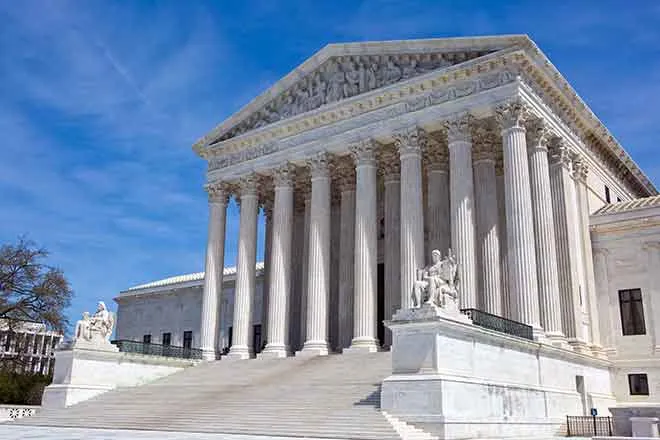
© iStock - SeanPavonePhoto
More than two dozen organizations writing briefs for a pivotal U.S. Supreme Court case on the future of climate change had ties to fossil-fuel linked companies, according to a new report.
Consumer Watchdog, a nonprofit advocacy group based out of California, released a report on Monday drawing connections between 25 organizations that filed amicus briefs to the U.S. Supreme Court ahead of arguments in Suncor v. Boulder County Commissioners.
The case, which challenges whether state and local governments can apply laws to regulate activities that may contribute to climate change, will be heard by justices on the high court October 5.
Members of the Boulder County Board of Commissioners in Colorado sought to use local nuisance laws to sue ExxonMobil and Suncor for damages related to climate change. The commissioners argued that the two companies contributed to fossil-fuel drilling, which is connected to increased greenhouse gas emissions.
The report from Consumer Watchdog found 25 of 38 entities that submitted briefs to the high court in support of Suncor and ExxonMobil are financially connected to the defendants or other funds in the fossil-fuel industry itself.
The Manhattan Institute, U.S. Chamber of Commerce and the Buckeye Institute all submitted briefs in support of ExxonMobil and Suncor while receiving funding from one or both companies, according to the report.
“Many of the amici in Suncor invoke public interest-branding such as ‘transparency,’ ‘accountability,’ and ‘fairness,’ but are in fact part of a broader influence campaign funded and shaped by oil, gas, and coal companies that have contributed to the climate crisis,” the report reads.

Memebers of the Supreme Court of the United States 2022 - WIkimedia - Public Domain
Advocates for Suncor and ExxonMobil have warned that the Colorado case could set a precedent for allowing states to regulate climate change laws across the country, leading to a patchwork of legal decisions.
“You're going to see people come back to the till again and again in an attempt to govern the national economy from state laws,” said O.H. Skinner, executive director of the Alliance for Consumers. “The answer of ‘Well Congress could just pass uniform law that tramples all the states equally is a really sad outcome because we are supposed to have a federal system for a reason.”
The report’s writers argued that Colorado is not seeking to create nationwide policy, instead opting for damages from Suncor and ExxonMobil. However, lawyers for Boulder County and the City of Boulder have claimed to seek more than $100 million in damages over the next three decades.
Skinner and other advocates said this figure would cripple the productivity of energy companies across the world.
“The Colorado Supreme Court concluded that the possibility a damages award may influence business conduct does not automatically transform a tort lawsuit into unconstitutional regulation,” the report’s authors said.
Consumer Watchdog slammed several organizations that wrote amicus briefs on behalf of Suncor and ExxonMobil. The report also pointed to allegations that Justice Samuel Alito may have improper financial ties to parties involved in the case.
The authors pointed to Alito’s connection with Paul Singer, founder of the Elliott Investment Management, a firm linked to Suncor. Alito allegedly flew on Singer’s private jet in 2008 but did not disclose the trip, according to the report.

Alito’s wife also holds mineral interests at an Oklahoma property after she agreed to lease the land to an energy company of which Elliott Investment Management holds a majority stake.
On the other side of the case, several groups have called on Justice Elena Kagan to be recused over allegations of a conflict of interest in favor of the government in Boulder.
In the letter, analysts point to Kagan’s authorship of a foreword in the Fourth Edition of the “Reference Manual on Scientific Evidence” published by the National Academies of Science, Engineering and Medicine in December 2025.
The manual included a chapter on Climate Science, where it referenced the “attribution theory.” The theory is used to posit that scientific modeling is used to attribute the effects of climate change from greenhouse gas emissions.
The advocates argued that Kagan’s authorship as part of the manual is evidence she is unable to make an unbiased decision in Suncor v. Boulder County Commissioners. The Constitution requires justices on the Supreme Court to recuse themselves from consideration of cases in which “impartiality might reasonably be questioned.”
So far, neither justice has recused themselves from consideration of the case. Justices on the high court are expected to hear the case on October 5, the first day of arguments in the upcoming term.